Choosing between Erg Chebbi and Erg Chigaga
Most people picture a single dune sea when they think of the Moroccan Sahara, but there are two, and the choice you make at the planning stage decides almost everything else about the trip: the drive time, the budget, the camp standard, and even the colour of the sand in your photographs.
The quick answer
Pick Erg Chebbi if your total Morocco trip is a week or less, you fly into Marrakech or Fès, and you have never seen a dune before. Pick Erg Chigaga if you have ten days or more, you are booking a private 4×4 transfer out of M’hamid, and you want a camp two hours from another human. There is no in-between worth booking, and the third option some operators sell, Zagora dunes, is a sand sample on the way to Chigaga that you should skip.
Erg Chebbi, the access-friendly Sahara
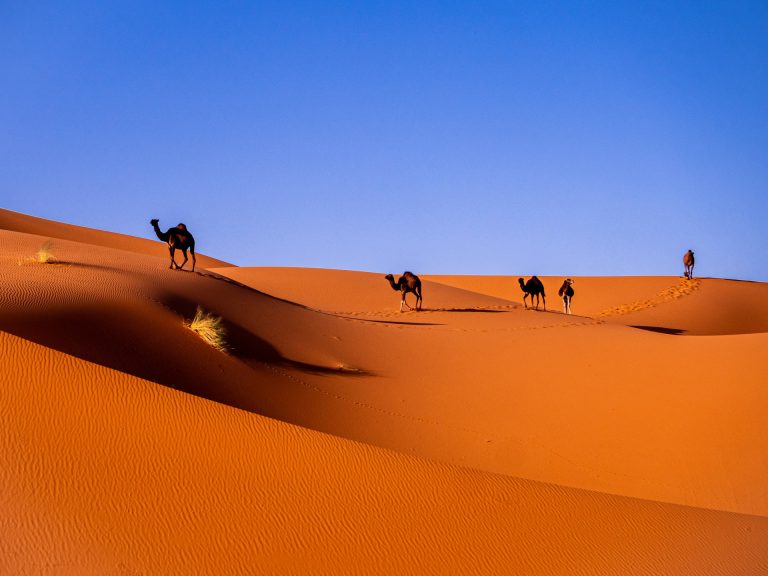
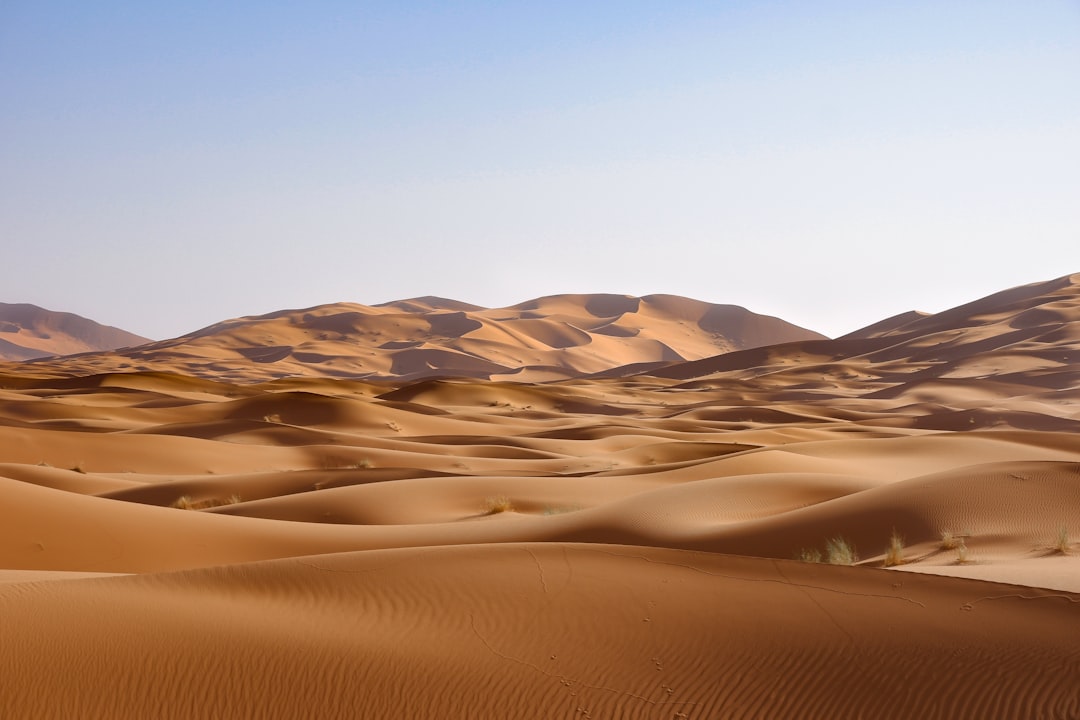
Erg Chebbi, the dunes outside Merzouga, is the one in every advertisement. You can reach the edge of the sand by paved road, which means the access is fast, the camps are dense, and a one-night camel ride is on the menu for almost every package tour out of Marrakech or Fès. The route from Marrakech is the classic three-day loop: day one across the Tizi n’Tichka to Aït Benhaddou and Ouarzazate, day two through the Dadès and Todra gorges into the dune country, day three the camel ride and the long drive back. From Fès, it is a single ten-hour push south on the N13, broken at Ifrane and Midelt. If you have three days total and you have never been near a dune before, this is the right call. The colour at sunrise is the photograph you have been shown.
The downside is density. Erg Chebbi has roughly 200 camps along a fifteen-kilometre dune wall, and the standard tour itinerary funnels everyone to the same sunset ridge at the same hour. If you arrive between October and March, you will share that ridge with two hundred people from a dozen other camps. Solitude is buyable at Chebbi, but it costs. The luxury operators who own the camps on the southern end of the erg, away from the village of Hassi Labied, charge two to three times the standard $50 to $80 per-person rate. They earn the markup with electric lighting, fixed showers, a dinner that is not tajine on a propane burner, and an empty ridge for the sunrise photograph.
Erg Chigaga, the long-haul Sahara
Erg Chigaga, further south, is what people mean when they say the real désert. You do not drive there. You four-wheel out from M’hamid for an hour and a half over a flat, dark plain that ends in a sudden wall of sand. The camps are sparser, fifteen of them spread over an erg the size of Paris, against two hundred at Chebbi. The sky, away from any electric light at all, is dark enough after midnight that the Milky Way reads clearly to the naked eye, which is the reason astrophotographers pick Chigaga over Chebbi every time. If you have a week and you are willing to take a longer transfer, this is the one to pick.
The catch is the transfer. From Marrakech to M’hamid is a full driving day on the N9 over the Tizi n’Tichka, then another half day west along the Drâa valley through Zagora. Most travellers split the route with a night in Aït Benhaddou or Ouarzazate before pushing on, often pairing the stop with the Saâdian-era kasbah at the ksar entrance. Once you have added the transfer back, a Chigaga trip from Marrakech is a five-day commitment minimum. From Fès, add another day. If the trip’s total length is eight days, the désert eats five of them, and you will be on the road more than you are on the sand.
Camp choices and what to ask before booking
Camp listings on Booking.com and GetYourGuide blur the difference between a $50 mattress in a shared tent and a $300 private suite with a wood-burning stove. The star ratings do not help. Five questions cut through it:
- Fixed shower or wash basin? A camp that answers “wash basin” is a budget operation. Fine for one night, miserable for two.
- How many tents on the camp? Six to ten is the sweet spot. Above twenty, you are at a hotel that happens to be canvas.
- How long is the camel ride to camp? The honest answer is forty-five to ninety minutes. Longer and you arrive sore enough to skip dinner; shorter and you are at a camp next to the parking lot.
- Is dinner included, and what is on the menu? Tajine is the default. A camp that mentions m’choui (slow-roasted lamb) or bread baked in the sand has at least one staff member who cooks for a living.
- Sunrise wake-up: do they walk you to a private ridge or pile everyone into a shared SUV? Good camps walk. Dense ones share a viewpoint with three other camps.
Café stops and where to break the long drive
The désert drive is long enough that where you stop matters. From Marrakech the standard breaks are at Aït Benhaddou for the Saâdian-era kasbah, at Ouarzazate for a tagine at Café Mouflon (the post-house favoured by film crews), and at Boumalne Dadès for the gorge approach. From Fès the breaks are at Aïn Leuh and Ifrane (the Atlas village with the cèdre forêt of the Moyen Atlas) and Midelt for an apple-orchard café lunch served behind the mairie.
Skip the petrol-station meals: the food is heated tinned tagine and the coffee is filtré. Stopping at a properly chosen café for thé à la menthe and a homemade pâtisserie is part of the trip, not a delay. The Café de France in Tinejdad keeps a Berbère menu that two generations of the Aït Atta have signed in the visitors’ book, and the patron speaks enough English to walk you through what is on the brûleur that day. If you are driving with children, plan a halt every ninety minutes: the road climbs and descends through the Atlas in a way that turns four hours of map distance into six hours of actual time behind the wheel, and a child who has not stretched in two hours becomes a problem on the next pass.
Food at the camps and what to expect at dinner
Dinner at a standard désert camp is a three-course tajine night: a harira soupe to start, the tagine itself (chicken with préserved lemon, or lamb with prunes from the Tafilalt), and a fruit-and-pâtisserie dessert. Some camps add a méchoui (whole lamb slow-roasted in a sand pit) on request, but it requires advance notice of at least 24 hours because the cook lights the pit before sundown. Bread is khobz cooked in a small clay oven at the camp and served warm with olive oil from the Drâa palmeraie. Mint tea, the thé à la menthe poured from height, follows the meal and continues until you ask for it to stop.
Alcohol is not standard at camps: this is a Berbère hospitality model, not a hotel bar. The luxury camps on the southern end of the erg keep a small bar with wine from the Meknès vignobles and the occasional bière Casablanca; standard camps do not. If a glass of wine with dinner matters to you, ask before you book and accept the price increase, or carry a bottle in from Marrakech. Customs allows one bottle of spirits or two of wine per traveller, and the desert is not the place to discover the camp is dry.
Getting to Merzouga: drive or fly
For Erg Chebbi, there is a flight nobody mentions in the package brochures: Royal Air Maroc runs a daily Casablanca to Errachidia hop out of the Aéroport Mohammed V (with an onward connection from Marrakech-Ménara), ninety minutes in the air, that drops you a ninety-minute drive from Merzouga. Errachidia is also a Hertz and Avis rental pickup. If your trip is short and you would rather not spend three days on the N9, this is the move. Cost is $80 to $140 each way, often cheaper than the fuel and the night’s accommodation for the standard road trip.
One quiet note for travellers who plan to push past Chigaga: the frontière with Algeria runs forty kilometres south of M’hamid and has been closed since 1994. The southern road dies at the gendarmerie checkpoint. The Aït Atta valleys to the east and the Drâa palmeraie to the west are the only directions worth driving once you are past Zagora; the road south is a dead end, no matter what an enthusiastic Marrakech taxi driver tells you.
For Erg Chigaga there is no flight. You drive, or you let a tour driver drive you. Self-driving the route is feasible in any rental sedan as far as M’hamid; from there, you switch to the operator’s 4×4 for the off-road stretch into the erg. A rental car parked at a guarded M’hamid lot runs about 20 dirham a day, which is the small footnote nobody puts in the brochure but which makes the difference between a smooth trip and a logistical headache.
Photography and the night sky
The dunes look orange in the marketing photographs because every brochure shoot times its shutter for the fifteen minutes after sunrise, when the sand is warm-lit and the eastern sky is still cool blue. The window closes fast. By 8 a.m. between April and October, the sun is high enough that the dunes flatten into a uniform yellow and the shadows die. Plan to be on the ridge at first light. The afternoon equivalent is worse: only the last twenty minutes before sunset carry the deep colour, and that is when every camp’s camel train converges on the same ridge.
For the Milky Way, Chigaga is the answer. Light pollution at Chebbi is real (Merzouga and Hassi Labied glow orange to the west), and the camps that string fairy lights along their dining tents wash out the sky overhead. Chigaga camps run on solar and switch off at 10 p.m. The new-moon week of each month is the booking target. A tripod, a 20-second exposure at f/2.8 ISO 3200, and the galactic core climbs out of the eastern horizon by 11 p.m. from April through September.
Budget: what each trip costs end to end
The numbers below are the realistic per-person, two-traveller costs for the standard packaged trip, in U.S. dollars at the 2026 exchange rate. Solo travellers add roughly 30 percent for the single-tent supplement.
| Component | Erg Chebbi (3-day) | Erg Chigaga (5-day) |
|---|---|---|
| Shared 4×4 transfer or tour | $180–260 | $320–480 |
| Camp night (standard) | $60–90 | $90–140 |
| Camp night (luxury) | $160–280 | $220–360 |
| Meals on the road | $45–70 | $80–120 |
| Total (standard) | $285–420 | $490–740 |
A private 4×4 with a driver bumps either total by $200 to $400 across the trip, and is worth it for couples who want flexibility on stop length. A self-drive to Merzouga (Chebbi only) is cheapest at around $190 a day for the rental and fuel combined, but you still pay the camp directly.
Common questions
Is one night in the desert enough?
For Erg Chebbi, one night works if your camp is on the quieter southern end and you arrive in time for sunset. You ride in around 5 p.m., eat at 8, sleep, wake for the 6 a.m. sunrise ride out. For Erg Chigaga, one night is wasted: by the time you have driven six hours from Marrakech and started the drive back after four hours of sleep, you have burned two days for a single ridge. Chigaga makes sense at two nights minimum. If your itinerary will not stretch, take Chebbi and skip Chigaga rather than rush the longer trip. The day-trip “desert” excursions from Marrakech that promise the Sahara in 24 hours visit the Agafay stone plateau, not real sand, and the misnaming on the package title is the first warning sign that the quoted price hides what the package delivers.
Can children handle the camel ride?
Children over six handle the camel ride fine. Camels at Erg Chebbi are tied nose-to-tail in trains of six to ten, walked at a slow pace by a guide on foot. The ride is uneventful and lasts forty-five to ninety minutes depending on which camp you booked. Children under six get tired faster and may want to ride in front of a parent on a shared saddle, which most camps will allow if you ask in advance. The bigger concern with younger children is the cold at night between November and February (camp temperatures drop to single digits Celsius after midnight) and the climb out of the dune to the sunrise viewpoint, which is steeper than it looks from the camp’s terrasse. Pack a fleece per child and one warmer top layer than you think you will need.
The Agafay desert question
Agafay is the stony semi-désert thirty minutes south of Marrakech that operators have rebranded over the past five years as a Sahara substitute for travellers who cannot spare three days. It is not sand. The landscape is flat scrubland with low rolling hills, and the camps that have opened there serve a useful purpose (a sunset dîner, an overnight near Marrakech, a backdrop for the trip photograph) but they do not replace the Sahara. If your trip is too short for Chebbi, book the Agafay dinner-and-camel package for what it is: a pleasant evening near the city. Do not book it under the impression that you are seeing the Moroccan dunes, because you are not, and the cost of having paid for the wrong thing is the regret of not having seen the real thing on a future trip to the Aït Atta valleys further south.
Bottom line
Book the trip that fits your week, not the trip you wish you had time for. Erg Chebbi over three days is a complete Sahara experience; Erg Chigaga over five days is a deeper one. Trying to squeeze Chigaga into the time slot built for Chebbi produces the worst of both. Whichever erg you pick, book a single fixed-rate désert package out of Marrakech, Fès, or M’hamid that bundles the long drive, the overnight camp, and the camel hour. Compare current departures and camp standards in our guide to the best desert tours from Marrakech rather than piecing together the transfers and the camp yourself: the cost is similar and the logistics are not where you want to be spending your first day in the country.