Remote Work Friendly Stays in Taghazout
Taghazout has the wrong reputation in remote-work circles. The Atlantique surf village 18 km north of Agadir gets pitched as either a beach-hostel scene for backpackers or a yoga-retreat town for the wellness crowd; the working-from-the-corniche population that books a séjour of 30 days every winter is the third audience and the quietest. The third population (developers, designers, marketers, freelance writers) who book a month here every winter is the quietest of the three, and the one this article is for. The internet works at fibre speeds in the right buildings, the time zone aligns to European business hours, and the cost of a month is one-third of what the same stay would run in Lisbon. The trick is picking the building.
The quick answer
Book a fibre-equipped apartment at Munga Guesthouse, Surf Maroc Villa Mandala, or Sundeck Apartments for $35 to $90 per night in the November-to-April high season. All three carry 100+ Mbps fibre, redundant 4G fallback, and reliable power. Skip the cheap hostels on the village’s lower street (their wifi runs at 5–15 Mbps and dies at peak surf hours), skip the standalone Airbnbs that do not list speed-test screenshots, and stay at least four nights to amortise the airport transfer and the household setup. The Taghazout Cowork on the seafront opens at 8 a.m. with paid-day access at 120 dirham.
Internet quality: what to expect by building
Maroc Telecom rolled out the fibre to the central section of Taghazout village in late 2022, with the cable reaching the seafront properties and the side streets up to the second row from the corniche. The third row and higher (the older houses on the slope up to the surf shops) are still on copper VDSL at 30–60 Mbps; everything below the corniche road has 100–500 Mbps fibre depending on the package the landlord pays for. The single most underrated check before you réservez: ask the propriété to send a recent Speedtest capture d’écran (Speedtest.net or fast.com), taken in the soirée, not in the matinée. Morning speeds are deceptively fast; evening speeds tell you what the connection does when the village wakes up.
For a video call (Zoom, Google Meet, Teams) you need 5 Mbps up and 10 Mbps down stable. For uploading a 1 GB vidéo file to S3 or a Loom export, 30 Mbps up is the floor. For multi-monitor screen-share with code running in a remote container, 50 Mbps each way is the comfortable bracket. The fibre buildings hit all three; the VDSL buildings hit the first two but slow the file transfers to a coffee-break pace. The Airalo eSIM at 100 dirham for 10 GB is the right backup for any internet outage: tether the laptop, finish the meeting, complain to the landlord about the redundancy after.
The five stays that work for remote work
1. Munga Guesthouse, the all-rounder
Munga is a 12-room boutique guesthouse on the corniche, with fibre to every chambre (300 Mbps down, 80 Mbps up confirmed at peak hours), proper bureaux in the larger rooms, and a quiet ground-floor café with the same wifi for the days when the room view becomes distracting. Rates run $55 to $95 per night for a couple’s room with breakfast, monthly rates negotiated direct (typically $1,200 to $1,800). The owner runs a strict “no parties, lights out by 11 p.m.” policy in the residential section, which the remote-work crowd appreciates and the backpackers complain about. Walking distance to the Taghazout Cowork (5 minutes), Sol House yoga shala (3 minutes), and the village’s two main coffee shops (Munga Café and Surf Cafe).
2. Surf Maroc Villa Mandala
The Villa Mandala compound is the upmarket Surf Maroc property in the central village, with eight chambres, a piscine, a roof yoga deck, and the most reliable fibre in town (Maroc Telecom enterprise package, redundant Orange 4G fallback, génératrice backup for the village outages that hit twice a month). Rates $90 to $140 per night, monthly rates around $2,200 to $2,800. The property targets the wellness-meets-work crowd (a sunrise yoga class is included, the in-house chef cooks a daily three-course dinner at $25 extra), and the staff handle the practical errands (laundry, airport transfer, dentist appointments) that the lower-tier stays leave to you. The right pick for travellers who want the work-stay experience without the household friction.
3. Sundeck Apartments
The Sundeck is a four-unit immeuble on the second row from the seafront, with full appartements (cuisine, salon, chambre, terrasse) rather than guesthouse rooms. Fibre runs at 200 Mbps down, 50 Mbps up, with the line shared between the four units, which holds at full speed up to three concurrent video calls (the fourth call hits a slight drop). Monthly rates $1,000 to $1,400 per apartment. The trade-off against Munga or Villa Mandala is the household: you cook your own meals, your own coffee, your own laundry, with no front-desk help. For travellers who actively want the apartment-rental feel of a longer stay (without the Airbnb roulette on wifi quality), Sundeck is the cleanest pick.
4. Amayour Surf House (mid-tier, for shorter stays)
Amayour is a 15-room mid-range surf house on the corniche, with wifi at 80 Mbps down, 20 Mbps up, and a small ground-floor common room with desks. Rates $35 to $65 per night, monthly rates around $850 to $1,200. The trade-off is the surf-house atmosphère: the morning is a 7 a.m. surf-lesson check-in chaos at reception, the evening is a 6 p.m. wax-board-and-beer wind-down, the wifi takes a slight evening hit when the surf-camp guests upload their GoPro footage. For travellers in Taghazout 1 to 2 semaines who want a budget option with a surf-house ambiance, Amayour delivers. For pure remote-work concentration over a month, Munga or Sundeck is the meilleur fit.
5. Olo Surf and Yoga (the wellness option)
Olo Surf and Yoga is the long-running French-owned propriété on the south end of the village (15 minutes’ walk from the central seafront), with chambres, a yoga studio, a petite piscine, and a cuisine serving organic Moroccan-French dîners. Wifi runs at 120 Mbps down, 25 Mbps up, with a dedicated coworking room with three desks and an external monitor available for guests. Rates $70 to $110 per night, weekly packages with yoga included around $700. The location is the trade-off: 15 minutes from the village centre, more peaceful, but the Taghazout Cowork day visit becomes a walking commitment. The right pick for travellers whose work routine includes a morning yoga class and an early afternoon ocean swim built into the schedule.
Coworking: the three options that exist
The dedicated coworking infrastructure in Taghazout is small but functional. The three operating spaces:
- Taghazout Cowork (the main option). Seafront location, 30 desks, two phone booths, fibre at 300 Mbps each way, monitors available for rent. Pass à la journée 120 dirham, weekly 600, mensuel 1,800. Café inclus, déjeuner from the in-house café 70 dirham. Open 8 a.m. to 10 p.m. seven days a week. The community is roughly 60 percent European (Berlin, Lisbon, Amsterdam, London), 25 percent North American, 15 percent Moroccan and other. Most desks are claimed by 10 a.m. on weekdays.
- Surf Maroc Cowork (members only). Smaller (12 desks), upstairs at the Surf Maroc village headquarters on the corniche. Access is bundled with Surf Maroc accommodation; not available to walk-ins. The fibre is the same as Villa Mandala (enterprise-tier, generator-backed). Quieter than the main Cowork; the right pick if you are staying at a Surf Maroc property already.
- Munga Café (informal coworking). The ground-floor café at Munga Guesthouse is the unofficial spillover coworking spot when the Taghazout Cowork is at capacity. No desks, but the seating is comfortable, the wifi is fast, and the staff understand the laptop-and-coffee crowd. Coffee 25 dirham, full breakfast 80 dirham, sandwiches and salads at lunch.
Practical logistics
The aéroport is Agadir Al Massira (AGA), 35 km south of Taghazout, 45 minutes by petit taxi (200 dirham négociés before you get in, no meter use) or 30 minutes by the Souk Larba autobus (15 dirham, runs every 90 minutes during daylight). Pre-book the transfer through your stay; the Taghazout-bound shared minibus from Agadir’s bus station runs every hour for 25 dirham but takes 90 minutes and requires the bus-station change. For a month-long stay, the petit taxi from the aéroport is the right $20 spend on arrival; for short stays the shared minibus is fine.
Cash is the standard payment for everything in the village. Bring 3,000 to 5,000 dirham in cash for the first week (the ATM at the Banque Populaire on the seafront caps at 2,000 per withdrawal and runs out of cash on weekends), or withdraw at the larger ATMs in Agadir’s Marina district on the arrival run. Le paiement par carte is accepted at the upmarket restaurants (Surf Cafe, Munga Café, the seafront grill) but not at the local taxi, the épicerie, the boulangerie, or any of the surf-shop board rentals. Credit-card travellers underestimate the cash dependency on first arrival.
Daily rhythm and what work looks like
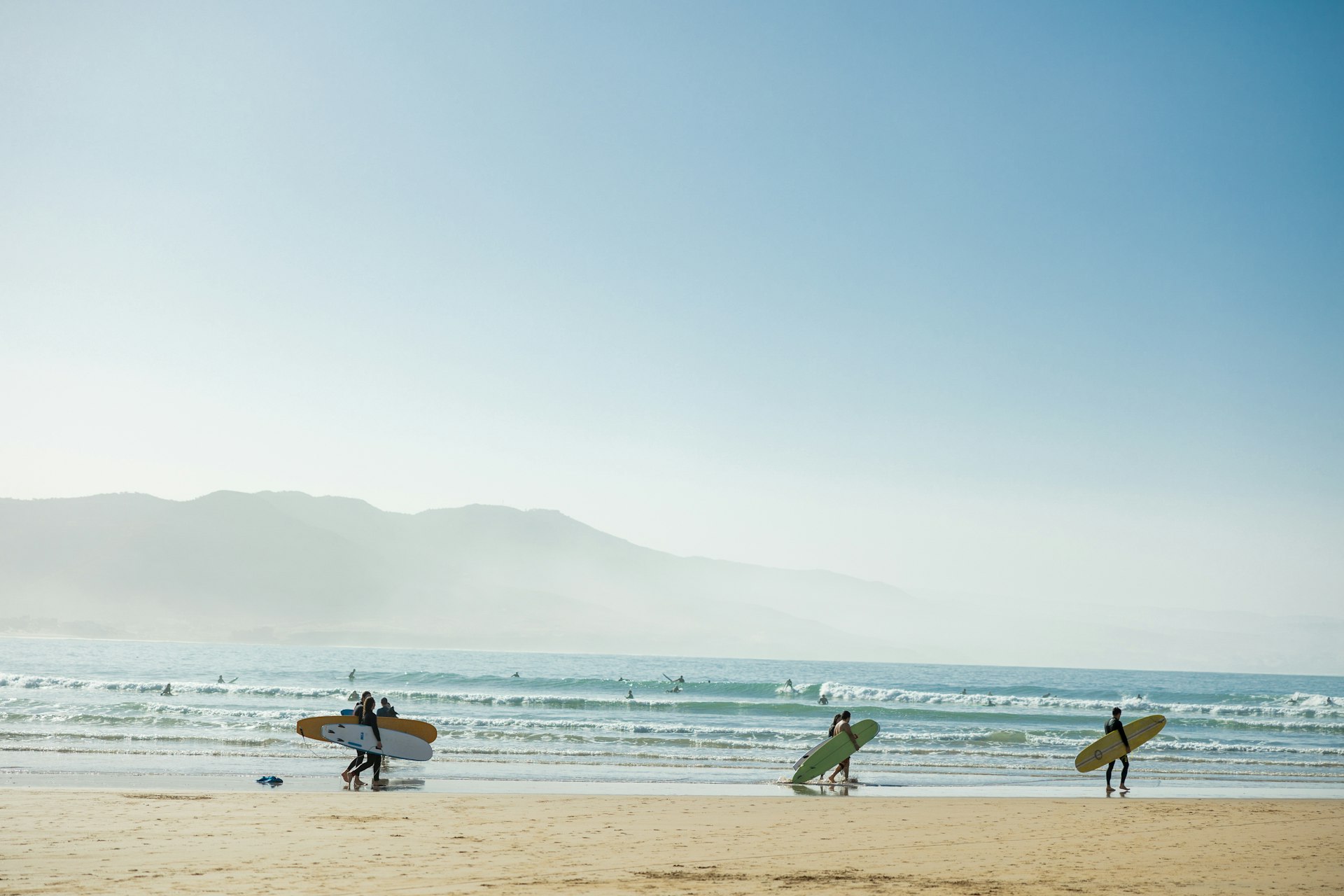
The remote-work crowd in Taghazout falls into one of two rhythms. The morning-surf rhythm: in the water at 7 a.m. for the dawn glass-off, breakfast at 9, at the desk by 10, deep-work block to 1, lunch and a swim, afternoon meetings, dinner at 8. The evening-surf rhythm: at the desk by 8 a.m. (European time zone alignment), morning meetings, lunch, afternoon shallow-work block, surf the 5 p.m. session, dinner at 8. The first rhythm suits Pacific-time-zone work (a 9 a.m. PT meeting is your 6 p.m. Taghazout), the second suits European-time work (a 10 a.m. CET réunion is your 9 a.m. Taghazout). Pick the rhythm by your meeting load.
The Taghazout context for a longer stay
Taghazout sits on the Atlantique côte 18 km north of Agadir, between the headland of Cap Ghir to the north and the river mouth at Tamraght to the south. The village is part of the Souss-Massa région, with the Anti-Atlas mountains an hour inland (Tafraoute is a popular jour-de-randonnée destination) and the Arganeraie biosphère reserve (the only place in the world where the arganier grows) inland from the corniche. The local population is mostly Chleuh Berbère; the dialect spoken in the village is Tachelhit alongside Darija Arabic, and the local épicerie owner switches to French or English depending on which tourist walks in. Long-stay travellers who pick up a few Tachelhit greetings (azul, tanmirt) are universally welcomed at the bakery and the café in a way the all-English visitor is not.
The food scene matches the village’s surf-and-yoga demographic: vegetarian and pescatarian options are abundant, the local Berbère fare (tagine d’agneau, harira aux épices, baghrir au miel) is excellent at the Café Mouja and the small Restaurant Berbère on the seafront, and the imported European fare (sourdough at Hash Point, espresso at Mouja, fish-and-chips at the seafront grill) is the comfort food when the daily tagine starts to wear thin. Argan oil from the Tighanimine cooperative inland is the universal souvenir; buy direct from the cooperative on a day trip rather than from a corniche shop with a marked-up bouteille and a polished marketing pitch. The argan oil cost in the cooperative shop is one-third of the price at the Agadir airport.
Common questions
Is Taghazout a safe long-stay base for solo travellers?
Taghazout is one of the safest small villages on the Moroccan côte for solo long-stay travellers, including women. The village is small enough (1,800 permanent residents, with the seasonal population doubling between November and March) that anyone staying more than two weeks is recognised by the local épicerie, the bakery, the surf shops, and the café owners; this informal network is the practical safety layer that a larger city does not offer. Street harassment is rare and lower than in Marrakech or Casablanca, partly because the village’s economy is tourist-driven and partly because the local code of conduct around long-stay foreigners has been worked out over fifteen years of European winter migration. Solo women report no significant issues and the long-stay female community is visible at the cowork, the yoga studios, and the evening cafés. The single common annoyance is the surf-school tout on the seafront in the morning, easily declined and never aggressive.
How does Taghazout compare to other Moroccan remote-work towns?
The three main Moroccan remote-work bases are Taghazout (surf-and-Atlantique), Marrakech (ville-et-culture), and Casablanca (ville-d’affaires-et-services). Taghazout is the cheapest and the smallest, with the best surf and the most laid-back pace; Marrakech has the strongest cafés-and-coworking variety (the Cowork in Gueliz, the Sundesk in the Mouassine, the Mr Wonderful in the Hivernage) and the richesse culturelle of a year-long séjour; Casablanca has the international corporate infrastructure (Regus, Wojo, AnfaPlace) for travellers running formal client work that needs a real salle de réunion option. Pick Taghazout for the surf-and-quiet stay, Marrakech for the culture-and-energy stay, Casablanca for the business-trip-as-remote-work stay. Most long-stay remote workers cycle between two of the three across a winter season, with Taghazout taking the longest single block (one to two months) and the city stays running two to four weeks each.
Can I bring my partner who does not surf?
Taghazout works as a couple’s base for the non-surfing partner, with a few caveats. The non-surf options in the village: yoga at the Sol House or Olo studios (cours à la séance 100 to 150 dirham), Arabic and French lessons at the Centre Linguistique on the corniche (300 dirham per hour, sessions en groupe cheaper), promenades de plage south to Tamraght (45 minutes one-way) or north to the pointe rocheuse (30 minutes), excursions to Paradise Valley (75 minutes by petit taxi each way) and Imsouane (90 minutes north). The non-surf partner risk is boredom in week three, particularly if the surfing partner spends 5 hours a day in the water. The combined-base solution is to spend the work week in Taghazout and the weekend in Essaouira (3 hours’ drive north, more cultural, restaurant scene at the Skala du Port) or in Agadir (45 minutes south, a proper city with cinemas and shopping malls for the rest-day variety). Couples who plan two-thirds Taghazout and one-third escapades de week-end report the highest satisfaction across a séjour of one mois.
Bottom line
For a month-long Atlantic winter remote-work stay in Morocco, Taghazout is the right base: cheap, calm, surf-adjacent, with the fibre infrastructure to handle real video-call work. Book Munga Guesthouse for the first stay, switch to Sundeck Apartments for the second once you know the village, use the Taghazout Cowork on the days the room view is too distracting. Filter your booking search to “monthly stays” and “fibre” before you commit, so it returns the right kind of place rather than the cheap-and-cheerful options that look fine on Airbnb until you try a 10 a.m. CET call. For more on the area, see our other Taghazout guides.