Tangier vs Marrakech: Which City Fits Your Travel Style?
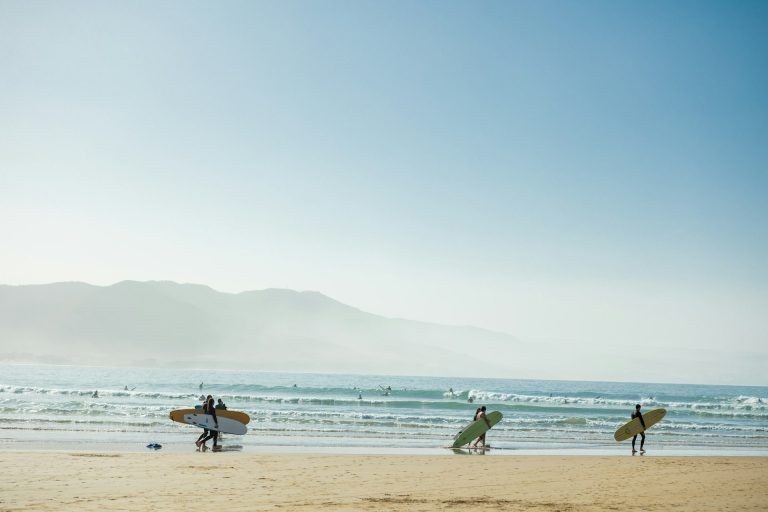
Tanger and Marrakech are the two Moroccan cities first-time travellers most often compare, and the comparison usually gets the trade-off wrong. Marrakech is the louder, denser, more sold version of Morocco. Tanger is the quieter, cooler, more European-adjacent option. Neither is better; they answer different questions. This article walks the seven dimensions that separate them in practice: vibe, food, walkability, day-trip range, climate, médina depth, and who each city is built for.
The quick answer
Pick Marrakech if your priority is dense souks, day trips to the Atlas and the Sahara, and the full-volume version of Morocco for a first visit. Pick Tanger if your priority is a calmer pace, a working ferry to Spain, the Mediterranean and Atlantic coasts within an hour, and a city where the European feel sits comfortably beside the Moroccan. If you have ten days, do both: Tanger first for three nights, then the train down to Marrakech for four. The order matters; Tanger after Marrakech feels small, Marrakech after Tanger feels like turning the volume up to 11.
City overview at a glance
| Dimension | Tanger | Marrakech |
|---|---|---|
| Population | 1.3 million (urban area) | 1.0 million (urban area) |
| Vibe | Coastal, European-adjacent, calmer | Souks, snake-charmers, high-energy |
| Médina size | Small, walkable in 90 min | Sprawling, 4–5 hour walk |
| Climate | Mediterranean, 12–30°C year-round | Hot continental, 8–42°C across year |
| Languages | Arabic, French, Spanish | Arabic, French, English (tourist zones) |
| Best for | Coastal walks, ferry trips, sunsets | Souks, riads, Atlas day-trips, desert base |
| Typical riad night | $70–130 | $90–180 |
| Day-trip range | Chefchaouen, Asilah, Tarifa (Spain) | High Atlas, Ourika, Essaouira, Sahara |
Side-by-side: the seven dimensions that matter
1. Vibe and tempo
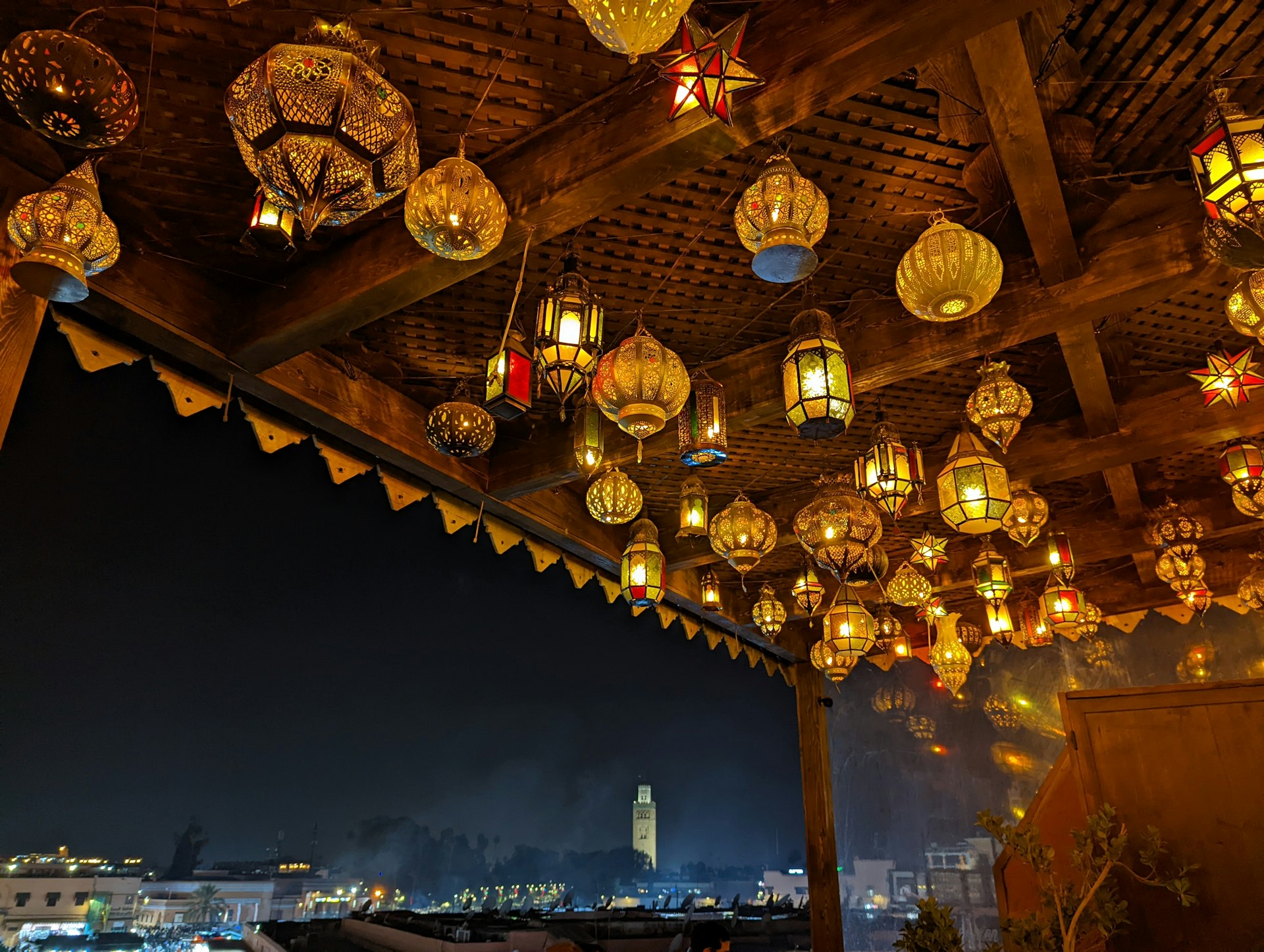
Marrakech runs at three speeds: dense souks during the day, full-volume Jemaa el-Fnaa at night, calmer riad courtyards in between. The energy is constant; the city makes demands. Tanger is the opposite: the rhythm is a Mediterranean port town crossed with a fading European résort, with long cafés on the Petit Socco, evening promenades along the Boulevard Pasteur, and a tempo that does not push you. The expat writers who lived in Tanger (Paul Bowles, William Burroughs, Truman Capote) did so because the city left them alone. The packaged tour operators who sell Marrakech do so because the city is the strongest Moroccan brand they can sell. Pick by which energy you want from a holiday.
2. Food
Marrakech has the larger restaurant scene, with the global-restaurant high end (Le Jardin, Nomad, Café Clock, Dar Yacout) and the budget grills around Jemaa el-Fnaa. The food is solid Moroccan with a creative-Marrakech overlay; tajines, harira, the occasional pastilla, lots of well-marketed dégustations for tourists. Tanger’s food scene is smaller but more interesting at the high end: a Spanish-Moroccan-Berbère fusion that the city’s port-town history produced, with restaurants like El Morocco Club, Le Saveur de Poisson, Casa Pepe (the Petit Socco tapas standby), and a half-dozen French-trained chefs running small dining rooms in the upper Kasbah. For seafood specifically, Tanger wins by a clear margin: the daily catch from the Mediterranean lands at the port at 6 a.m. and the restaurant menus rotate accordingly.
3. Walkability
Tanger is the more walkable city. The médina is small (90 minutes end-to-end at a slow pace), the ville nouvelle is laid out on a grid with the Boulevard Pasteur as the spine, and the cliff paths from the Marshan quarter to the Phoenician Tombs are pleasant fifteen-minute strolls between cafés. Marrakech’s médina is dense and rewarding but the alleys are not pleasant to walk in the July afternoon heat (regularly 38–42°C between June and August), and the ville nouvelle Gueliz district is car-dominated and uninspiring on foot. For travellers who plan to walk most of the trip, Tanger is the better choice; for travellers who plan to taxi between souks, riads, and excursions, Marrakech does the job.
4. Day-trip range
Marrakech wins this category outright. Within a three-hour drive: the High Atlas trekking from Imlil, the Ourika valley, the Essaouira coast, the Setti Fatma waterfalls, the Agafay rock-désert, and the Atlas Studios film tour at Ouarzazate. Within a five-hour drive: the Sahara dune access via Erg Chebbi or Chigaga (one of the country’s defining experiences). Tanger’s day-trip range is narrower but distinctive: Chefchaouen at 2.5 hours by car (the blue town), Asilah at 45 minutes (the small artists’ coastal village), Larache at 90 minutes (the Lixus Roman ruins), and Tarifa at 35 minutes by ferry across the Strait (a Spain day trip, passport required). For a trip that uses the base city as a hub, Marrakech offers more variety; for a trip that adds a country-jump to the itinerary, Tanger is the only Moroccan city with a daily ferry to Europe.
5. Climate
Tanger has a Mediterranean climate: mild winters (12–18°C), warm summers (22–30°C), rain mostly between November and March, no real cold and no real heat. The city is pleasant year-round. Marrakech is hot continental: cool winters (8–20°C), brutal summers (28–42°C), dry across the year. The August midday in Marrakech is the hottest sustained heat most Western travellers will ever experience on a city trip; everything closes between noon and 4 p.m. and you are reduced to the riad pool. Tanger does not have this problem. For a summer trip (July-August), Tanger is the better Moroccan city; for a winter trip (December-February), Marrakech’s daytime warmth beats Tanger’s grey damp.
6. Médina depth
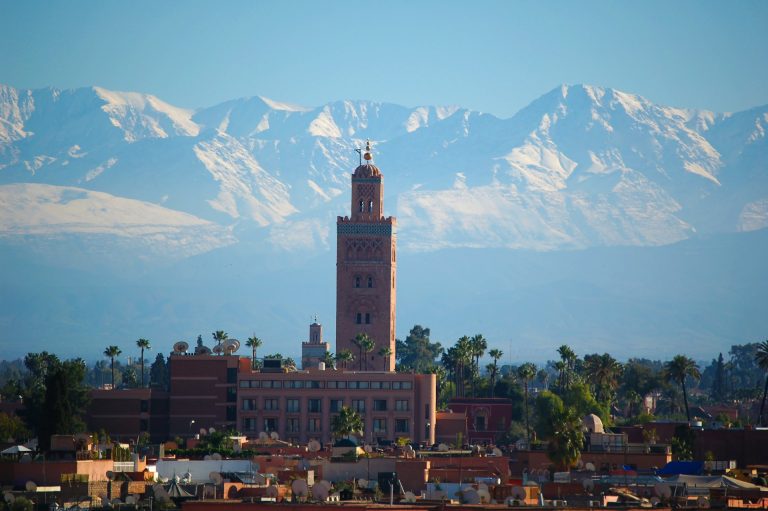
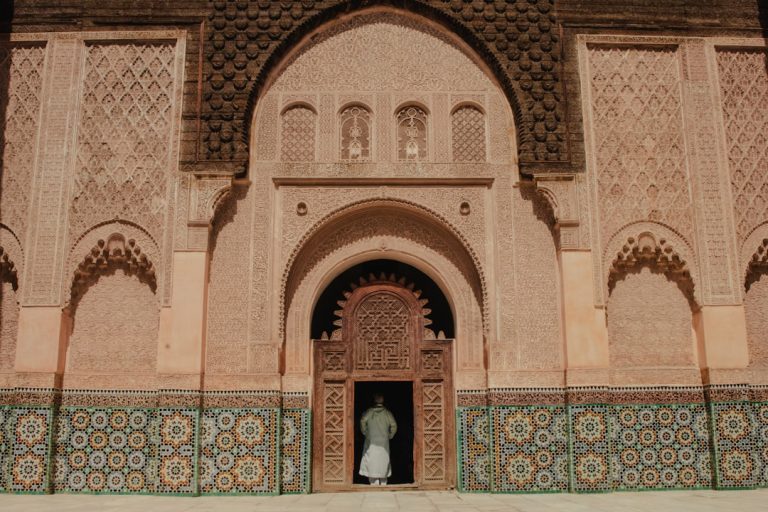
Marrakech’s médina is the more impressive single artefact: larger, denser, with the Saâdian Tombs, the Bahia Palais, the Ben Youssef madrasa, the Dar el-Bacha musée, and the Mouassine mosquée all inside the murailles. The souks are more specialised (Souk Smarine for textiles, Souk des Épices for spices, Souk Cherratine for leather, Souk Haddadine for ironwork), the artisan trades are more vivid, and the sense of being inside a working medieval city is stronger. Tanger’s médina is small and less spectaculaire but also less commercialisée, and the upper Kasbah quartier has the Musée de la Kasbah (the former sultan’s palais) and a view across the Strait of Gibraltar that Marrakech cannot match for any prix. For pure médina depth, Marrakech wins; for médina-with-a-view, Tanger.
7. The traveller each city is built for
Marrakech is built for the first-time visiteur who wants the carte-postale version of Morocco compressed into a week: souks, riad, désert, Atlas, the charmeurs de serpents, the Jardin Majorelle, the hammam. The city delivers it efficiently. Tanger is built for the visiteur de retour who has already done the Marrakech checklist and wants the more interesting Morocco: the coastal walks, the European-adjacent culture du café, the ferry to Spain, the long déjeuners at El Morocco Club, the coucher de soleil at Café Hafa. The right answer is not one or the other; the right answer is Marrakech on the first trip and Tanger on the second, or both on a long single trip with the train between them.
Best for specific traveller types
- Couples on a romantic week: Tanger has the cliff terrasse at Café Hafa and the El Morocco Club dîner; Marrakech has the riad pool and the hammam at La Mamounia. Tanger edges this for the calmer setting; Marrakech wins if your idea of romantic includes a Sahara overnight.
- First-time Morocco visitors with one week: Marrakech. The postcard checklist fits the time slot.
- Families with children under 10: Tanger. The smaller médina is less overwhelming, the beach at Cap Spartel is 20 minutes away, and the lower density of street hassle works better for families.
- Photographers and writers: Tanger. The light over the Strait, the layered history (Paul Bowles, Burroughs, the Beat era), and the calmer pace are more productive than Marrakech’s constant stimulus.
- Surfers and remote workers: Neither. Both are inland-feeling cities; head south to Taghazout or Essaouira for the surf, west to Casablanca or Rabat for the remote-work scene.
- Foodies on a high-end trip: Marrakech for variety, Tanger for the Spanish-Moroccan seafood specifically. Three days of each gives you the best of both food scenes without the overlap.
Booking recommendations
The right shape for a Tanger-and-Marrakech trip is open-jaw: fly into Tanger Ibn Battouta from Europe (the cheap Ryanair routes from Stansted and Brussels Charleroi), spend three nights in the Kasbah or the Marshan, take the high-speed Al Boraq train south (Tanger to Marrakech via Casablanca, 5 hours 15, $35 second class, $55 first), spend four nights in the Marrakech médina, fly home from Marrakech-Ménara on Royal Air Maroc or any of the European budget carriers. The train is the right choice over an internal flight: cheaper, scenic, and dropped right at the city centres in both endpoints.
For the Marrakech leg, sleep in the médina (Mouassine, Kasbah, or Riad Zitoun quarters), $90 to $180 per night for a comfortable couple’s room. For the Tanger leg, sleep in the Kasbah or the upper Marshan, $70 to $130 per night. The price gap reflects the demand difference; Marrakech is the more in-demand city for European weekend trips and the prices price that in.
Quartiers and ambiances side by side
The Mouassine quartier of Marrakech is the most rewarding sleeping area in either city: a maze of restored 17th-century riads, a fountain at every third intersection, the Souk Smarine ten minutes east, the Jardin Majorelle twenty minutes by petit taxi. The Kasbah quartier south of the Bahia Palace is the second pick: quieter, closer to the Saâdian Tombs, slightly cheaper. Tanger’s Kasbah quartier is the closest equivalent to Mouassine: small, intricate, with the Café Baba, the Café Tingis, and the Palais des Institutions Italiennes (now a galerie d’art) within five minutes’ walk. The Marshan plateau west of the Kasbah is Tanger’s Gueliz: residential, with the Café Hafa on the cliff, the Phoenician Tombs in walking distance, and a calmer evening ambiance.
Cuisine carries the differences too. Marrakech serves the souks-and-spices version of Moroccan food: the dégustation tasting menus at La Maison Arabe, the tajine-and-pastilla tasting at Le Tobsil, the m’choui d’agneau slow-roasted at Dar Yacout. Tanger serves the port-and-Spain version: the tortilla and the boquerones at Casa Pepe, the fish soupe at Saveur de Poisson, the daurade royale at El Morocco Club. The Tanger Café Hafa terrasse still pours the same thé à la menthe served in 1969, in the same Berbère-blue glasses on the same low tables; the Marrakech Café des Épices on the Souk Cherratine pours the same tea against a different backdrop of leather-worker stalls. Both rituals are Moroccan; neither replaces the other.
Common questions
Can I do both cities in five days total?
Five days is tight but doable: two nights in Tanger, three in Marrakech, the train between them on day three. The downside is the train day cuts into either the last Tanger morning or the first Marrakech afternoon, depending on which direction you go. A 7 a.m. departure from Tanger arrives in Marrakech by 1 p.m., which preserves the Marrakech afternoon for a Jardin Majorelle visit before dinner in the médina. The opposite direction (a 7 a.m. departure from Marrakech arriving in Tanger by 1 p.m.) preserves the Tanger afternoon for a Cap Spartel sunset, also a valid choice. Either way, day three is mostly the train. If your trip is six days or more, the cities each get a full third day, which is when the depth of each starts to show.
Is the high-speed train worth it over the standard ONCF service?
The Al Boraq high-speed line runs Tanger to Casablanca in 2 hours 10 minutes, a journey that took 4 hours 50 minutes on the standard ONCF before 2018. The second-class fare is 213 dirham, the first-class is 320; both include reserved seats, power outlets, and quiet carriages. From Casablanca onward to Marrakech the connection is the standard ONCF train (3 hours 10 minutes), which raises the total to 5 hours 15 with a 25-minute transfer at Casa Voyageurs. The alternative is the direct overnight ONCF train (10 hours, 350 dirham in a couchette), which is romantic in concept and uncomfortable in practice. Pay for the Al Boraq combined ticket on the ONCF site; the time saved is the value, and the carriage on the high-speed leg is the most comfortable rail experience in Africa right now.
Which city is safer at night?
Both cities are safe at night with the standard urban precautions: stay on lit routes (in Marrakech, the Mouassine to Jemaa el-Fnaa corridor and the streets around the major riads; in Tanger, the Petit Socco, the Boulevard Pasteur, and the lit corridors from the médina into the Kasbah), avoid the darkest alleys after 11 p.m. unless walking with a local, and use petit-taxi rides instead of long walks back from restaurants in unfamiliar quartiers. Solo travellers (both women and men) report no significant safety issues in either city, with the standard caveat that street harassment in Marrakech is louder and more frequent than in Tanger (the trade-off of a higher-traffic tourist city). Both cities have a visible présence policière in the tourist zones and a dedicated unité (the Brigade Touristique) that handles incidents impliquant foreign visitors. The réceptions in both cities maintain trusted chauffeur lists and will arrange a 50-dirham pickup from any restaurant on a phone call.
Bottom line
Marrakech is the right Morocco city for first-timers who want the postcard checklist; Tanger is the right Morocco city for return visitors who want the calmer, more European-adjacent version. Both together over 7 to 10 days is the best single Morocco trip you can take, with Tanger first and Marrakech second to ride the volume curve up. Compare the riad availability and rates for both cities side by side in our budget stays in Marrakech guide and our Tangier guides before you book; the price gap is real and the décision often turns on a riad you fall for in one city that decides the trip’s structure.