Where to Stay in Fez for First Timers
The first decision for Fès is which side of the city to sleep in, and the choice shapes every other thing about the trip. A first-time visitor sleeping in the ville nouvelle wastes half a morning each day getting to the médina; a first-time visitor sleeping deep inside Fès el-Bali walks straight into the trip’s best moments but spends ninety minutes lost on the first afternoon. The two right choices are a riad in the upper Talâa Kebira axis near Bab Boujloud, or a small kasbah-style hôtel a few steps outside Bab Jamaï in the Andalous quarter. Everything else is a compromise.
The quick answer
For a first-time visitor: book a riad in Fès el-Bali near Bab Boujloud or along Talâa Kebira, no further than 400 metres from the gate. Budget $80 to $140 per night for a comfortable couple’s room with breakfast. Skip the ville nouvelle (modern but disconnected from the trip), skip Fès el-Jdid (interesting but limited dining), and skip the Andalous quarter on a first visit unless you are deliberately picking a quieter side of the médina. Two nights minimum, three preferred.
Fès has three districts; you only need to consider two
Fès el-Bali, the old médina (where to sleep)
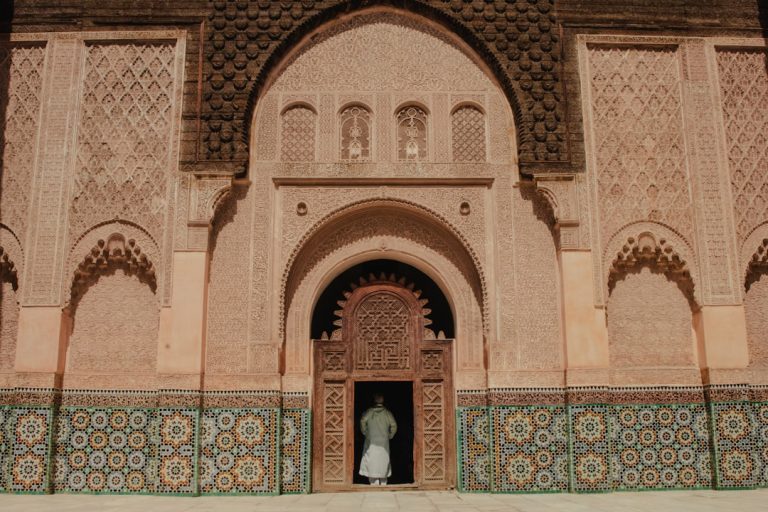
Fès el-Bali is the 9th-century walled city, UNESCO-listed since 1981, with around 9,400 alleys (yes, that count is real) and the largest pedestrian zone in the world. The northern half (around Bab Boujloud, the Blue Gate, and the Talâa Kebira souk axis) is the standard tourist artery: lined with shops, easy to navigate after the first day, walking distance to the Bou Inania madrasa, the Al-Qarawiyyīn university, and the Chouara tanneries. The southern half (around the Andalous quarter and Bab Jamaï) is quieter, older, and harder to learn. For a first visit, sleep in the northern half, walk into the southern half on day two.
Fès el-Jdid, the “new” 13th-century quarter (visit, do not sleep)
Fès el-Jdid is the Marinid extension, built in 1276, smaller than el-Bali and home to the Mellah (the old Jewish quarter), the Royal Palace gates, and the brass-makers’ market. A morning walk here is worthwhile; sleeping here is not, the dining options are limited and the after-dark feel is less hospitable than el-Bali. The Place du Vieux Méchouar at the Royal Palace gates is the photograph spot, but the surrounding accommodation is mid-tier business hôtels with no character.
Ville Nouvelle, the modern city (skip on a first visit)
The Ville Nouvelle is the French-built quarter from the 1920s, organised on a grid around Place de Florence and Avenue Hassan II, with chain hôtels (Sheraton, Ibis, Barceló), modern restaurants, and the train station for onward travel to Casablanca and Marrakech. For a business trip or a longer stay where you commute into the médina by petit taxi each morning, the Ville Nouvelle has its uses. For a first-time visitor on a 2-to-3-night trip, the daily 15-minute taxi each way and the disconnect from the médina’s evening atmosphère make this the wrong base. Save it for the last night before an early train departure.
The five riads worth booking in Fès el-Bali
1. Riad Laaroussa, the polished classic
Riad Laaroussa is a restored 17th-century palace in the Aïn Allou quarter, five minutes’ walk from Talâa Kebira. Eight rooms around a courtyard with a fountain, a hammam in the basement, a roof terrasse with a Sahara-style breakfast, and a kitchen that cooks one of the better Fassi pastilla in town. Rates run $180 to $260 per night with breakfast, more in May-June and September-October. The English-speaking staff handle the riad’s own guided médina walk (an excellent introduction on day one) at no extra cost. The single drawback is the price; for travellers willing to pay it, this is the easy default.
2. Dar Roumana, the food-focused option
Dar Roumana sits in the upper médina near the Bab Boujloud entrance, in a restored Mauresque townhouse with five rooms and a restaurant table that books out two weeks ahead. The chef cooks a daily-changing four-course menu drawn from the Moroccan-French tradition: a courgette tagine with chermoula, a méchoui d’agneau with cumin-roasted potatoes, a pastilla aux fruits de mer the evening you arrive. Room rates $150 to $220 per night; the dinner menu is $45 per person extra. For travellers who want to eat well without leaving the riad after a long day in the médina, this is the right pick.
3. Riad Anata, the boutique mid-range
Riad Anata is a Belgian-owned five-room riad in the Aïn Azliten quarter, ten minutes from Bab Boujloud. The rooms are warmer than the typical traditional Fassi style (some carpets, contemporary textiles, no overwhelming zellige), the breakfast on the terrasse is generous (eggs to order, m’semen, the Moroccan honey from a known apiarist in Sefrou), and the rate runs $110 to $160 per night. The owner Renske runs the riad like a small hôtel rather than a B&B, which is what most first-time visitors want without realising it.
4. Dar Bensouda, the heritage value option
Dar Bensouda is a 12-room dar (the larger cousin of a riad) ten minutes’ walk south of Bab Boujloud in the Ziat quarter. The building dates from the 17th century, has been in the same family for three generations, and the original tilework and cèdre carving are still intact. The rate runs $80 to $130 per night, the breakfast is the standard riad spread (m’semen, baghrir, hard-boiled eggs, three jams, mint tea), and the staff is the most Fassi-native of any riad on this list (the family runs the place, the cousins run the kitchen). The drawback is the building’s age: thin walls, a single fountain that runs all night, and a hammam on order rather than open daily.
5. Hôtel Sahrai, the modern alternative outside the médina
The Hôtel Sahrai is a 50-room design hôtel on the hill above Fès el-Bali (the Quartier Atlas), built in 2014, with a pool, a gym, two restaurants, and a view across the entire médina from every west-facing room. Rates $200 to $320 per night. The Sahrai is the right pick for travellers who want the visual experience of Fès without sleeping inside the médina: a 10-minute petit taxi each morning to Bab Boujloud, the city laid out below at sunset, and a return to a properly modern bedroom with a hot shower. Couples on a honeymoon, business travellers extending the trip with a weekend, and anyone who has already done the médina-riad experience on a previous Morocco trip find this the right fit.
Map and orientation tips for the first afternoon
Fès el-Bali is not laid out on a grid; it is a thousand years of accreted alleys with five reference points and a slope. The five points to memorise on arrival: Bab Boujloud (the blue-tiled main gate at the top of the médina), Talâa Kebira (the main artery running south from Bab Boujloud), the Al-Qarawiyyīn courtyard (the green-tiled mosque at the bottom of the slope), Bab Rcif (the lower gate, where taxis wait), and Bab Jamaï (the southern gate into the Andalous quarter). Everything else hangs off these five.
The slope is the orientation trick that locals will not explain but will use. Fès el-Bali is built on a hillside; the higher ground is north (near Bab Boujloud), the lower ground is south (near Bab Rcif). If you are lost, walk uphill until you hit a wider lane; the wider lane is always either Talâa Kebira or its parallel Talâa Sghira, both of which lead back to Bab Boujloud. This single trick saves 80 percent of the disorientation panics that first-time visitors report. Carry Google Maps with the offline Fès region downloaded; the GPS is reliable inside the médina alleys even where data is marginal.
What a typical first day looks like
Arrive at Fès-Saïss aéroport or the train station, petit taxi to the riad in Fès el-Bali (150 dirham from Saïss, 50 from the gare, the driver drops you at the closest car-accessible point and a riad runner walks you the last 200 metres). Drop bags, take the riad’s guided 4-hour médina walk (300 dirham, booked at check-in): Bou Inania madrasa, the Chouara tanneries with a sprig of mint to mask the smell, the Al-Qarawiyyīn courtyard glimpsed through the gate (non-Muslims cannot enter the prayer hall), the Souk el-Henna and the dyers’ quarter. Lunch at Café Clock in the médina or at Restaurant Number 7 near the Bou Inania for the better Fassi food. Afternoon free for the riad terrasse, the hammam, or a return to the Talâa Kebira with the map you now half-understand. Dinner at the riad (most riads cook on request with 24-hour notice) or at the Restaurant Dar Hatim in the lower médina for the family-style multi-course Fassi meal.
Common questions
Is the médina safe to walk at night?
Fès el-Bali is safe to walk at night, with the standard urban caveats: stay in the lit corridors (Talâa Kebira, the Place Seffarine, the Place Nejjarine, the Boulevard inside Bab Boujloud), avoid the darkest of the small dérbs after 10 p.m. unless you are with a local, and keep cash close but not visibly displayed. Solo travellers (both women and men) report no security issues, and the riad receptions all maintain a list of trusted petit-taxi drivers who will fetch you from a restaurant’s location at any hour for 50 dirham. The single common annoyance is unsolicited “guide” approaches in the early evening at Bab Boujloud (a polite “lâ, choukran” and a continued walk resolves it within ten metres), and the occasional faux étudiant who offers directions to the tanneries you did not ask for. Tip nothing for unwanted help. The médina at 11 p.m., once the souks shut, is unexpectedly calm.
Will I get lost? Do I need a guide?
You will get lost on day one for thirty to ninety minutes. This is unavoidable and not a problem in practice: the médina is small enough (roughly 1.2 km by 1 km) that any sustained walk in any direction hits a city wall, a major gate, or a slope orientation you recognise within twenty minutes. A guide for the first afternoon is worth the 300 dirham because it teaches you the slope and the five reference points, not because you need someone to navigate for you. After the first half-day with the riad’s guide, the rest of the trip is yours to walk alone with Google Maps and a paper map for backup. Avoid the freelance “guides” at Bab Boujloud who quote 50 dirham then expect 500 at the tanneries; the riad-booked guide at a fixed price is the better deal.
Is Fès worth two nights or three?
Two nights is the realistic minimum: arrival afternoon and a full day in the médina, then a half-day morning before the train or flight out. Three nights is meaningfully better because the second full day allows for the Ville Nouvelle market visit, a half-day trip to Meknès (40 minutes by train) or to the Volubilis Roman ruins (1 hour by car), and a slower second médina walk that ranges into the Andalous quarter and the Bab Jamaï area you skipped on day one. Four nights is overkill for most first-time visitors; the city is dense enough that three days is the sweet spot. Many travellers regret the two-night booking after the first day; few regret the three-night booking after the third. Compare current riad availability across Bab Boujloud, Aïn Allou, and Ziat before locking the length; our Morocco road trip itinerary shows how Fès fits into a bigger loop.
Bottom line
Sleep in Fès el-Bali, no further than 400 metres from Bab Boujloud, in a mid-range riad if you want comfort and an upper-tier riad if you want the design experience. Three nights is the right length, two is the floor. Take the riad’s guided médina walk on the first afternoon and the rest of the trip resolves itself. Compare current riad availability and the best rate for your dates before you book, and filter the search to “within the médina walls” so it returns the right neighbourhood instead of the Ville Nouvelle chains. For the wider trip, see our other Fès guides.